The crown is one of the most versatile types of dental restorations. When crafted and placed by a qualified dental professional, a crown can repair and strengthen a damaged tooth, protect a vulnerable tooth, and enhance both the function of the mouth and appearance of the smile.
While dental crowns can be constructed out of several types of material, our Naperville cosmetic dentist, David R. Newkirk, DDS, prefers to use porcelain to create these restorations. Our all-porcelain crowns can be made the same shade, texture, and translucency as your natural teeth and are the closest we can come to a totally natural look. Allow Dr. Newkirk and the rest of our experienced team to help you improve your oral health with all-porcelain crowns.
“Simply put, exceeded my expectations in every way possible. From the friendly and knowledge staff to the expertise of Dr. Newkirk.”
- What Are Porcelain Crowns?
- Porcelain Crown Benefits
- Porcelain Crown Candidates
- Metal Crowns vs. All-Porcelain Crowns
- Porcelain Crowns vs. Veneers
- Complementary Procedures to Dental Crowns
- Porcelain Crown Procedure
- Porcelain Crown Recovery
- Porcelain Crown Discomfort
- Porcelain Crown Longevity
- Porcelain Crown Alternatives
- Porcelain Crown Care
- Porcelain Crown Cost
- Choosing a Dentist for Dental Crowns
What Are Porcelain Crowns?
Also referred to as a “cap,” a dental crown is built to seamlessly replace the visible portion of a tooth. Placed atop teeth that have suffered chips, cracks, breaks, or severe decay, crowns are designed to aid in important processes such as speaking and chewing. Additionally, crowns are regularly incorporated into larger restorations and treatments, particularly dental implants and bridges.
What Are the Benefits of Porcelain Crowns?
Porcelain crowns can restore the functionality and aesthetic appearance of teeth by fully covering a tooth that has been damaged, which helps to improve its structural integrity. Additionally, porcelain crowns can provide the following benefits:
- Protect weakened teeth from additional wear and tear
- Enhance the appearance of a damaged tooth
- Restore a tooth after a root canal
- Act as the final restoration in a dental implant procedure
Who Is a Candidate for Porcelain Crowns?
Porcelain crowns can help patients who need to protect one or more teeth from further damage. Ideal candidates for the procedure include those experiencing a broken or cracked tooth, a large cavity that cannot be rectified with a filling, or teeth that have become weakened from decay or damage. A crown can also be utilized after a root canal.
Patients with more severe tooth damage may benefit from more intensive restorative treatments, such as dental implants or bridges.
Porcelain-Fused-to-Metal Crowns vs. All-Porcelain Crowns
Although the use of metal amalgam is much less common in today’s dental world, many dentists continue to place porcelain-fused-to-metal crowns on front teeth. While these crowns are white on the front, they have a metal foundation to help give them strength. There are a couple problems with a crown with a metal foundation.
The first is that an opaquer must be placed over the metal to mask its color. That can make the tooth look pasty or chalky. The second is that unless the crown is made by an exceptionally skilled ceramist, such as the one we have, there will be a darkening effect produced by that metal at the margin of the crown where it meets the tooth. This is at the gumline. That dark line can be camouflaged by keeping it under the gum. The problem is that our gums tend to recede as we get older, so that dark line can later show up. Besides not looking very good, the dark line is a giveaway that the teeth are fake.
Even from close range with the trained eye of a skilled cosmetic dentist, it can be difficult to pick out a false tooth in a smile if it’s made out of pure porcelain. Let’s illustrate with a case done by Dr. Newkirk.
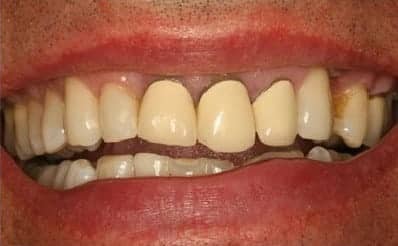
In the patient photograph above, it’s pretty easy to pick out the crowns. They’re on the patient’s two central incisors and one lateral incisor. The color is flat, and he has that characteristic dark line at the gumline beginning to show. This is a typical look for porcelain-fused-to-metal crowns.
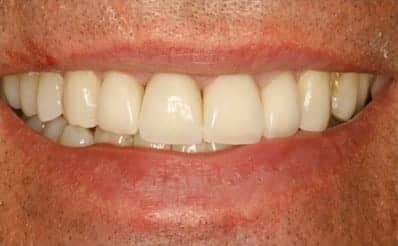
Here, Dr. Newkirk replaced the old dental work with beautiful all-porcelain crowns and some porcelain veneers to complete a smile makeover. Can you tell which teeth have porcelain on them and which are completely natural? It’s practically impossible to tell. As such, Dr. Newkirk believes that all-porcelain crowns are the best option for most of our patients.
Porcelain Crowns vs. Veneers
While porcelain crowns and porcelain veneers both cover visible aesthetic concerns, there are key differences between the two dental treatments. Porcelain veneers mainly address cosmetic imperfections by covering the front of the tooth with a thin and durable shell. The treatment can improve the color, shape, size, length, and spacing of a tooth. Veneers can be a great option for patients who have a relatively healthy tooth, but just need a little more of a visual upgrade.
While porcelain crowns can also enhance the appearance of a tooth, they can also restore the structure of a damaged tooth with a full coverage “cap.” Decay is removed from the tooth and the customized dental crown is then placed over the remaining portion of the tooth for natural-looking results. Porcelain crowns take restoration a step further and are generally a better choice if a tooth requires more of a functional correction.
Complementary Procedures to Dental Crowns
While dental crowns can beautifully restore a damaged tooth on their own, they can also be part of a broader smile enhancement plan. When multiple cosmetic (and, in many cases, restorative) procedures are combined into one, we call it a smile makeover.
A smile makeover is entirely customizable and can include virtually any treatment you want. For example, if you are already getting a crown placed, porcelain veneers may be incorporated into your procedure to refine the shape and shade of visible teeth and produce a seamless aesthetic. Your smile makeover may also include composite white fillings or bonding to repair minor imperfections elsewhere in the mouth, or professional teeth whitening to ensure your newly crowned tooth matches a bright, refreshed smile.
No matter your unique needs, Dr. Newkirk will be happy to work with you to recommend any complementary procedures to best enhance your final result.
What Does the Porcelain Crown Procedure Involve?
Before determining that you need a dental crown, Dr. Newkirk will perform an in-depth examination of your oral health. During this initial visit, he will create a plan to meet all of your needs, which may include additional procedures (e.g. implants, bridges, or porcelain veneers) or treatments aimed to prepare your tooth for a crown, such as removal of enamel or decay. You will be given a temporary crown to wear while your permanent restoration is being built.
Using our state-of-the-art digital impressions system, Dr. Newkirk will then take an impression of the tooth or teeth to be treated and submit it to our ceramist, who will match the data to lifelike shades of porcelain. At your next appointment, Dr. Newkirk will remove the temporary crown and attach the custom-crafted crown using a durable cement or bond.
What Is Recovery Like After Dental Crowns?
Most patients experience minimal downtime after receiving a dental crown. With this in mind, it’s normal to have mild sensitivity or tenderness near the treated tooth for a few days following the procedure. Over-the-counter pain medication is usually sufficient to manage any discomfort.*
Dr. Newkirk advises avoiding hard or sticky foods immediately after treatment to allow the cement to fully set and the surrounding tissues to adjust. Within a short period, your crown should feel completely natural when you bite, chew, and speak. Follow-up visits may be scheduled to ensure your bite alignment and comfort are ideal.
Is It Painful to Get a Porcelain Crown?
The application of dental crowns is not typically considered a painful procedure, but some patients report a slight pressure when the crowns are first placed. This sensation should fade as the patient gets used to the restoration.
How Long Do Porcelain Crowns Last?
When cared for properly, porcelain crowns can last for years at a time, occasionally even exceeding a decade. That said, in order to keep your crowns looking beautiful and functioning optimally, it’s important to practice good oral hygiene. This includes brushing at least twice a day, flossing every night, and attending regularly-scheduled dental exams.
Are There Alternatives to Crowns?
Multiple dental treatments are available to address damaged teeth, and the severity of your needs can determine which might work best. For more aesthetic improvements and small structural fixes, porcelain veneers, composite bonding, and tooth-colored fillings may be ideal. For those with severely damaged or missing teeth, dental implants and dental bridges may be preferred. Dr. Newkirk will develop a personalized treatment plan for you after the initial consultation that includes the best dental procedure for your needs.
How Do I Care For My Porcelain Crowns?
Porcelain crowns typically last anywhere from five to 15 years, if not longer, when cared for properly. Aftercare for porcelain crowns includes maintaining a good oral hygiene routine, like brushing twice a day and flossing at least once daily. Since crowns can become susceptible to wear and tear over time, avoid chewing on ice or excessively hard foods. This can lower the risk of them cracking or breaking. In addition, you should schedule routine dental exams to ensure your crown stays in good shape.
How Much Do Porcelain Crowns Cost?
The cost of a porcelain crown typically ranges from $1,000 to $2,500; however, it should be noted that the price depends on several factors, such as:
- The number of crowns being placed
- Preliminary treatments (e.g. enamel or decay removal)
- Additional procedures or restorations
For your convenience, we accept all major credit cards and most dental insurances. Please feel free to reach out to our friendly team with any financial questions.
How Do I Choose a Dentist for Dental Crowns?
Choosing the proper provider is essential to achieving long-lasting, natural-looking results with dental crowns. Look for a dentist with extensive training in cosmetic and restorative dentistry who emphasizes both function and aesthetics in every restoration. Additionally, viewing before-and-after photos can help you gauge the dentist’s artistry and precision, while patient testimonials can offer insight into their communication style and care philosophy. It’s also wise to choose a practice that uses modern materials and techniques, such as all-porcelain restorations customized for a perfect color and fit.
If you would like to find out if all-porcelain crowns can transform your smile, we welcome you to contact us today.
Medical Resources*
News-Medical